Herding
framed: 67 3/8 × 89 3/8 × 2 1/4 in. (171.1 × 227 × 5.7 cm)
- Common Ground 2021
- Jaune Quick-to-See Smith: Kincentric Art
Pastoreo
1985
óleo sobre lienzo
adquisición del museo, bonos de obligación general 1985
PC1986.98.1
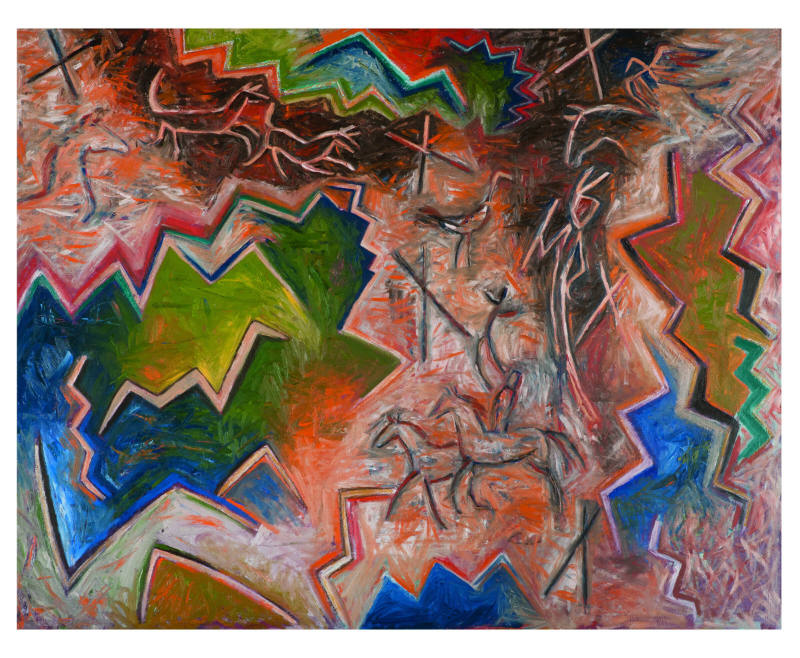
Herding es un ejemplo del estilo pictográfico y simbólico de Jaune Quick-to-See Smith. Las figuras de animales y los símbolos de esta pintura están inspirados en imágenes históricas de la cultura indígena americana. La calidad elemental de estas marcas pictóricas y luminosas tiene cierto aire «prehistórico y aborigen» según Quick-to-See Smith y la conectan con los creadores de arte ancestral del pasado. Los perros y los caballos corren con energía por el lienzo, mientras otros animales, cruces y figuras humanas aparecen esparcidos por toda la pintura. A la derecha de la zona media de la pintura se ve una posible imagen antropomorfizada de un conejo de pie que parece sostener un palo o un arco. El conejo, que a lo largo de la historia ha representado la fertilidad, suele aparecer con frecuencia en el arte rupestre histórico de los indígenas americanos y es un recordatorio de la compleja civilización y la riqueza artística que existía en América antes de la invasión europea.
Criada principalmente por su padre, Quick-To-See Smith pasó gran parte de su infancia explorando las zonas rurales y cultivando su amor por la tierra. Su estilo de vida durante la niñez inspiró su pasión vital por los caballos, animal que abunda mucho en su obra. La herencia indígena de Quick-to-See Smith, que era de ascendencia shoshone, salish y cree francesa ocupa un lugar central en gran parte de su obra y sus pinturas con frecuencia abordan la identidad a lo largo de la historia y en la sociedad moderna de la actualidad. La artista encuentra una continuidad estética entre el arte indígena americano histórico y contemporáneo. El simbolismo, tanto universal como personal, está en el núcleo de gran parte de su obra.
Jaune Quick-to-See Smith
Flathead Salish
born 1940 Flathead Reservation, Montana; lives Corrales, New Mexico
Herding
1985
oil on canvas
museum purchase, 1985 General Obligation Bonds
PC1986.98.1
Herding is an example of Jaune Quick-to-See Smith’s pictographic or symbolic style. The animal forms and symbols in the painting are inspired by historic Native American images. The elemental quality of these bright and painterly marks feel “aboriginal and prehistoric” to Quick-to-See Smith; connecting her to ancestral art makers of the past. Dogs and horses run energetically across the canvas as other animals, crosses, and human figures are interspersed throughout. A possible anthropomorphized image of a standing rabbit appears in the right central area of the painting and seems to be holding a stick or bow. Historically representing fertility, the rabbit is frequently seen in Native American historic rock art and is a reminder of the complex civilization and artistic richness that existed in America prior to European invasion.
Raised primarily by her father, Quick-To-See Smith spent much of her childhood exploring rural areas and cultivating a love for the land. Her childhood lifestyle inspired a life-long passion for horses, and the animal can be seen in several of her artworks. Quick-to-See Smith’s Native heritage, of Shoshone, Salish, and French-Cree descent, is central to her work and her paintings frequently address identity throughout history and in today’s modern society. She finds aesthetic continuity between historic and contemporary Native American art. Symbolism, both universal and personal, is at the core of her work.